
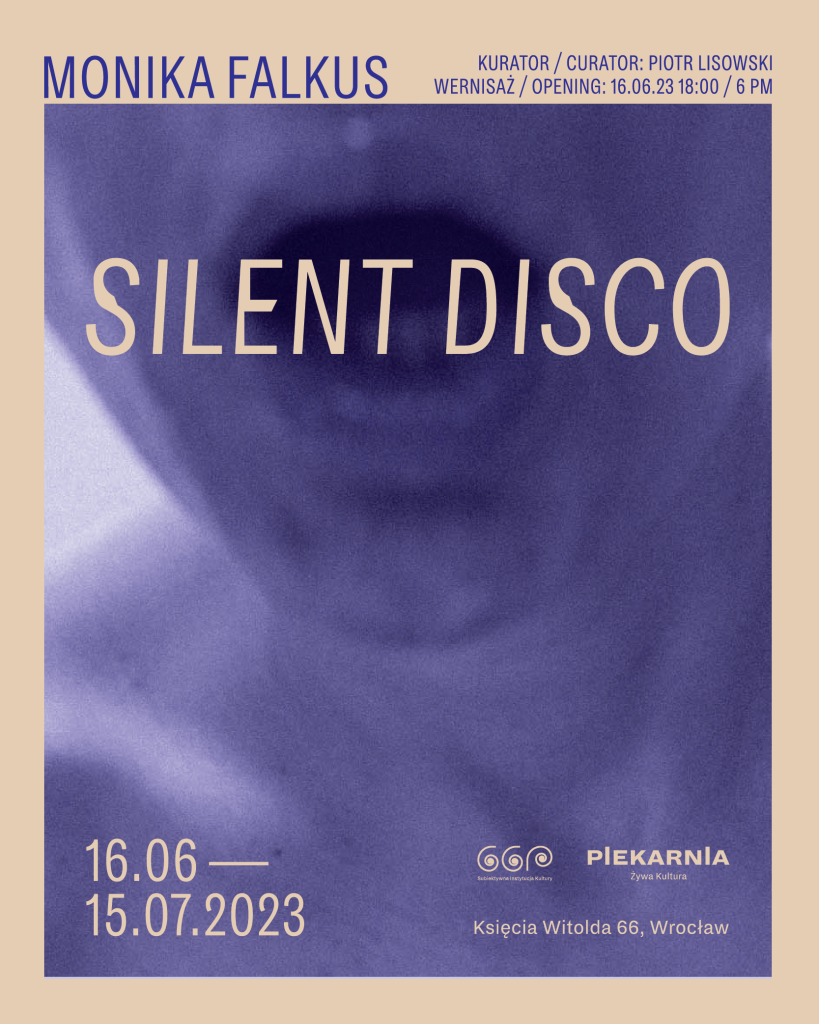
curator: Piotr Lisowski
exhibition: 16.06 – 15.07.2023
In 2021, Monika Falkus remarked: ‘I want so badly to be with someone, and at the same time I want so badly to be alone. It is healthy to feel lonely. Seclusion is meant to prompt our bodies to pursue relationships, just as hunger requires appetite. Yet, when I am hungry, I try to trick my body by drinking plenty of water. Perhaps I can substitute the need for intimacy with conversations on Messenger and masturbation’. Following the words of the artist searching for love, we step into emptiness and fear. It is no coincidence that ambivalent feelings and contrasting emotions become the central motif guiding the exhibition’s narrative.
The titular Silent Disco takes place within the body, in its physical and mental layers. The body needs a reason to move. A touch that may be both affectionate and oppressive. Skin flushes, muscles flex, hands clench. Bitten lips try to whisper, only to give a vomitous grimace a moment later. Hands dangle involuntarily, and legs trot in place. The radical changes of gestures and movements turn into a ritual, choreographed by subsequent layers, this time those of myths and legends, fables and dreams, stereotypes and personal encounters.
In her artistic practice, Monika Falkus constructs complex statements by drawing on her own experiences, the iconography of art history and contemporary culture. She translates the explored themes mainly into the language of painting and video works. These are often accompanied by writings structured as an intertextual grid composed of literary fiction, observations, and bibliographical references. Monika seeks to adopt different perspectives; her ‘micro-stories’ are subjective narratives that expand the visual forms. Through her work, she reflects on the need to pursue relationships and the extreme emotions involved in the process.
The Silent Disco exhibition becomes a kind of psycho-sociological ritual, with dance and loneliness playing a significant role. The former is, on the one hand, a form of bodily expression subject to rules and often codified conventions; on the other, it can also serve as an unrestrained form of improvisation and emancipation. It belongs to the religious and cultural sphere, as well as to entertainment, focusing on the exploration of various cognitive processes. Above all, dance may be perceived as relational art. Loneliness, by contrast, is the opposite of the relationship-building process, as it often results from exclusion, fear or the inability to fit in.

Monika Falkus’s works deal with the clash with the void, the encounter with reality that usually entails pain and disappointment, but also awareness. Consequently, they strive to expose the abusive mechanisms related to the transgression of the sphere of intimacy and the objectification of the body. The artist focuses on tensions and contrasting emotions. She juxtaposes corporeality with oppression, loneliness with the crowd, and silence with presence.
The theme in the background is the Sleeping Beauty fairy tale credited to Charles Perrault, although popularised by the Brothers Grimm and later by Disney films. As with many other fairy tales, here, too, the original differs significantly from the commonly-known versions. Perrault drew the story from a 1634 tale by Giambattista Basile, in which the prince does not wake the princess up with a kiss, but rapes her. That said, it all starts with a wicked fairy who curses the princess at birth, declaring that she would prick her finger with a spindle and fall into a deep sleep. Despite efforts and protection, the young princess Aurora, driven by curiosity and passion, ends up hurting herself with a needle.

Monika Falkus picks out this motif of touch above all by referring to the soundtrack from one of the most classic animated adaptations of the tale from 1959. In the cited scene, Aurora, controlled by the words ‘Touch the spindle’, finally makes this gesture. The artist, however, writes her own fairy tale, in which the visual forms of the paintings, the to-camera video actions, as well as the textual commentary and the sound filling the exhibition space, tell the story of the consequences following the touch. The touch remains an impulse, not necessarily to fall asleep.
Jakub Buchner, Silent Body [part of the Silent Disco exhibition], 2023, 11′ 38″
Exhibition guide

Monika Falkus (born 1993) – graduate of painting at the Academy of Fine Arts in Katowice and of art history at the University of Silesia in Katowice. Her work is focused on oil painting, creating installations, and video arts. She penetrates the subjects of love and women’s nature related to intimacy and sexuality. In her activities, she draws from tradition, fables, and her personal memories. She believes that moods have colours.
fot. Adrian Lach