
26 Jan–4 Mar 2023
It’s as if we have finally achieved the ability to make such virtual realities materialize, and in so doing, to reduce our lives, too, to a kind of video game, as we negotiate the various mazeways of the new bureaucracies.
David Graeber
Man does not suffer so much from poverty today as he suffers from the fact that he has become a cog in a large machine, an automaton, that his life has become empty and lost its meaning.
Erich Fromm
In his essay Rules for the Human Zoo,[1] Peter Sloterdijk outlined a vision of society as a combination of a zoological garden and a theme park. He argued that humans, wherever they appear, inevitably produce a “park effect” around themselves. City parks, national parks, provincial or state parks, eco-parks – they are all testimony to the intransigent human tendency to regulate, subjugate and normalise the environment along with all its inhabitants. Humanity appears to Sloterdijk as a “breeding” force, with the human community unevenly divided into “breeders” fulfilling their “taming-training-educational” tasks and the rest – submitted, often unconsciously, to formative processes.
Jarosław Potoczny’s works, especially his most recent installations, manifest a peculiar affinity with Sloterdijk’s notion of society as a field integrated by a “zoo-political” apparatus of pressure. The artist in his practice often makes references to artefacts known from the history of culture and uses symbols that are so deeply ingrained in our consciousness that they might even seem to have been overexploited. In Potoczny’s art, these cultural references undergo a peculiar degradation – religious emblems are transformed into office lighting and colourful LEDs, Hellenistic vase paintings becomes stickers on industrial barrels, national emblems turn into minced meat, while famous masterpieces – into faux fur and stamps. The current exhibition chiefly consists of plastic, LED fluorescent lights, carpet, silicone, cables, neon and self-adhesive film – materials known from office buildings, banks, gyms or shopping malls, i.e. the main embassies of the late capitalist “society of achievement” (to which we shall return later in the text). The exhibition space is dominated by the figure of the “classical” Cretan labyrinth, albeit with walls delineated by electric fence, which can be inscribed, to borrow Sloterdijk’s phrase, in “Europe’s pastoral folklore.” It becomes a sarcastic metaphor for social life seen as a system of “breeding” based on the restricting and formatting of citizens.
We are exposed to the violence of public rules from an early age. As Mikołaj Marcela argues in his books, the most common educational methods used in kindergartens and schools are rooted in the behaviourist study of animals (typically kept in cages), with the underlying belief that “change in human behaviour can be planned, induced and internalised by consistently applying a properly designed sequence of reinforcing stimuli.”[2] In addition to teaching based largely on the “application of patterns and schemes, following specific rules and thinking in accordance with a specific answer key,” educational institutions also condition students to work according to an imposed mode – humbly sitting behind a desk.[3] In this way, we are trained to become a “productive” part of modern society, which Byung-Chul Han describes as a “society of achievement.” The Korean philosopher points out that Foucaultian discipline and punishment have now been replaced by an ethos of achievement, self-actualisation and productivity. As self-starting entrepreneurs, in order to compete more effectively, we optimise ourselves to death. We become our own project: “However, the change from subject to project does not make power or violence disappear. Auto-compulsion, which presents itself as freedom, takes the place of allo-compulsion. This development is closely connected to capitalist relations of production. Starting at a certain level of production, auto-exploitation is significantly more efficient and brings much greater returns than allo-exploitation, because the feeling of freedom attends it.”[4]
Social life is increasingly dominated by the dictate of the market, while power is dissolving in a neo-liberal system operating through rights (and under the banners of egalitarianism and tolerance), which, under the guise of various freedoms, constitute an instrument of control present at virtually all levels of life. As Saul Newman succinctly puts it, “We are inserted into an apparatus which seeks to capture every facet of existence and desire within its circuits— of consumption, communication, spectacle, hyper-visibility, idiotic enjoyment, endless and meaningless work, debt and constant insecurity Spaces are provided for individual differences and tastes, but only through their commodification, thus producing unparalleled conformity. This regime no longer cares what we think – we are granted a certain freedom of thought – as long as we obey through our everyday practices, behaviours and rituals.”[5] We are subjected to ubiquitous surveillance; Foucault’s panopticism is reborn in a much more powerful and efficient digital form of the aperspectival panopticon – no longer having a centre, but co-created, as a network, by everyone and subject to surveillance from all sides.[6] Of course, in the digital panopticon we also “expose” ourselves with a sense of freedom.
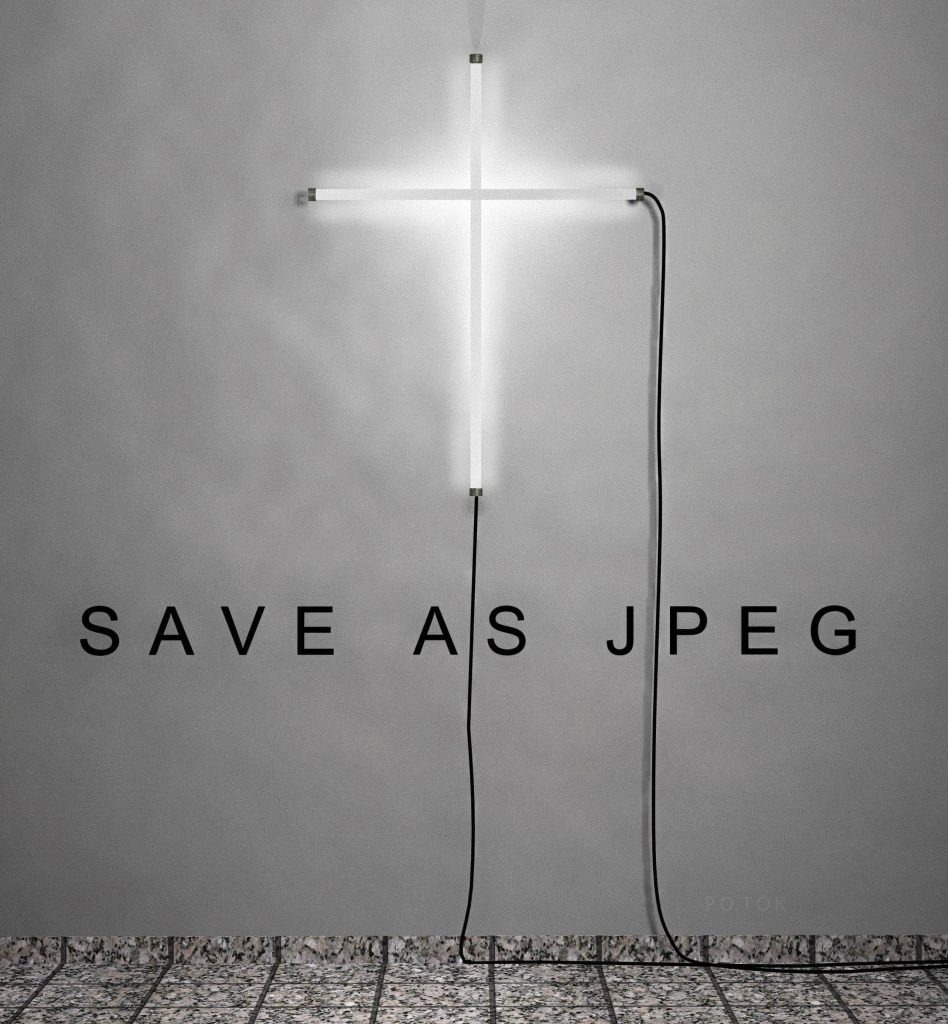
Jarosław Potoczny, Save as jpeg, instalation project
The Save As exhibition is a bitter reflection of these observations. It paints a not-so-optimistic picture of entanglement in a camouflaged system of constraints that shapes our lives through educational, legal, political, economic and cultural mechanisms. There is no alternative here, only a path marked out by the maze engulfing the gallery, through which, in the name of our safety (as well as well-being and freedom), we are kindly guided by an electric fence. The maze seems to stand for all the meaningless complexities of any bureaucracy, which disciplines bodies and minds through administrative means. As David Graeber argues, “like a maze, paperwork doesn’t really open on anything outside itself.”[7] The cross from the Save as JPEG installation does not herald salvation; instead, it signifies a repeated attempt to format the individual. It is a symbol of the replacement of communal relations with the hierarchical structure of institutions. Standardisation is the new ideological gospel, establishing dogmas, distributing authority and ranks. Images depicting the blueprints of the V2 flight programmer – the first-ever ballistic missile – alongside the characteristic outline of the pumpjack, used in oil extraction, are ironically exclusive objects whose faux fur and neon lights show the tools of exploitation of human life and environmental resources, telling a further story of social dissymmetry, distribution of power and wealth, and consequently – of the process of taming, fencing off and appropriation.
It seems impossible to break free from Sloterdijk’s “human zoo” – the social park whose rules define the world order, making the prevailing forms of economic and political power appear best or even necessary – after all, we are governed in the name of our freedom. In spite of these rather gloomy reflections, Logic appears – an installation that may be a kind of escapist summersault and at the same time a fig given to the prevailing clichés. Contrary to the title, the levitating scooter prompts us to reject patterns certified as “logical” – in the situation of being entangled in the dominant, ostensibly universal discourse, the only sensible thing to do is to distance oneself from it and exercise indifference. Refusing to participate in a game whose rules we have not set and trying to find a new perspective by freeing the imagination is perhaps the only way to develop a “new freedom,” one form of which may be, to quote Sloterdijk again, “ecstatic uselessness towards everything.”[8]
[1] P. Sloterdijk, “Rules for the Human Zoo: A Response to the Letter on Humanism.” Environment and Planning D: Society and Space 27 (2009): 12-28.
[2] M. Marcela, Patoposłuszeństwo. Jak szkoła, rodzina i państwo uczą nas bezradności i co z tym zrobić?, Krakow, 2022, p. 17.
[3] Ibid., pp. 48 and 303.
[4] B.-Ch. Han, The Burnout Society, transl. Erik Butler, Stanford, 2015, pp. 46-47.
[5] S. Newman, Postanarchism, Cambridge, 2016, p. 33.
[6] Cf. B.-Ch. Han, op. cit.
[7] D. Graeber, The Utopia of Rules. On Technology, Stupidity and the Secret Joys of Bureaucracy, New York, 2015.
[8] P. Sloterdijk, Stress and Freedom, Cambridge, 2015.
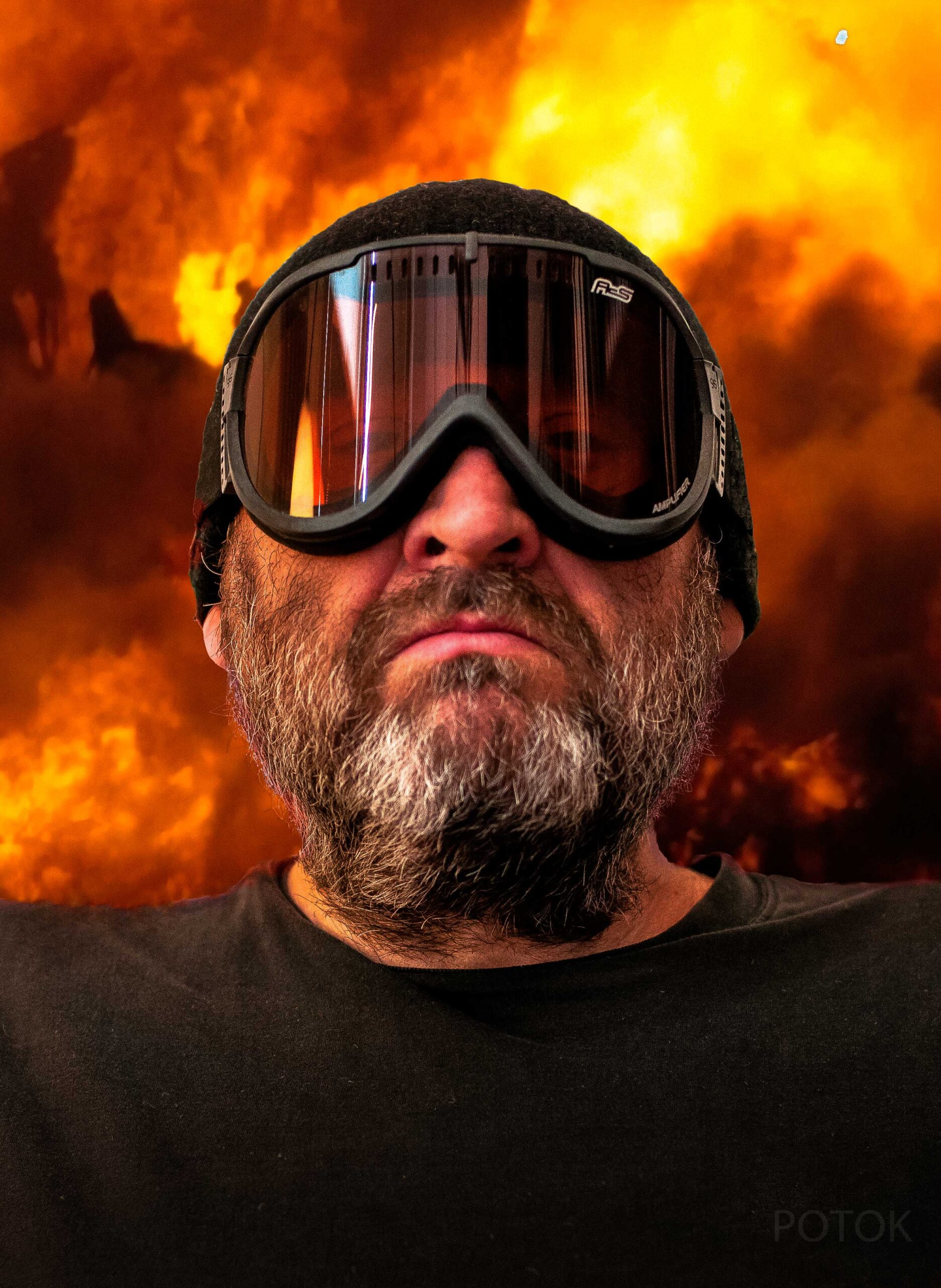
Jarosław Potoczny (b. 1962) – has graduated from the E. Geppert Academy of Art and Design in Wrocław (diploma in Prof. Konrad Jarodzki’s studio). His practice is based on painting, objects and installations. He uses his own formal language, reaching for materials from the surrounding “technical civilisation” – electrical elements, cables, plastics, neon signs, fragments of car components.He is interested in contemporary technology, pop culture and sociopolitical mechanisms. He lives and works in Wrocław.
Exhibition guide
Exhibition organiser: 66P Subjective Institution of Culture
Production: the 66P team