
Rumour Has ItMaciek Cholewa
curator: Joanna Kobyłt-Schodowska
opening: 16 July (Thursday), 6 p.m.
tour led by the artist and curator: 18 July (Saturday) 2026, 3 p.m
exhibition duration: 16 July – 5 September 2026
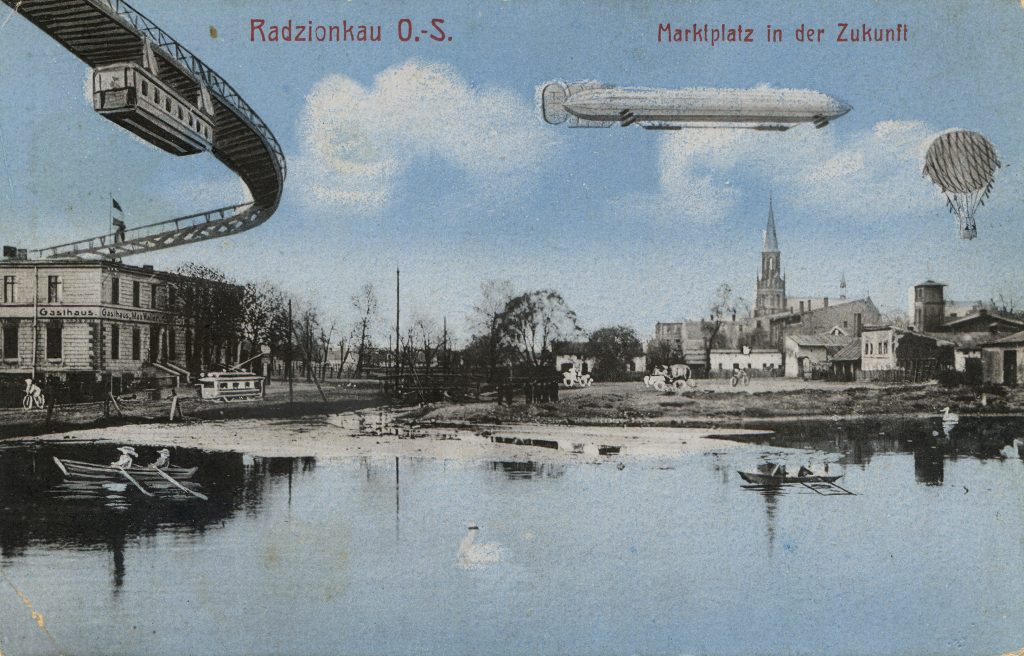
A postcard from 1914 depicts the Upper Silesian town of Radzionków. At the time of its publication, the town – then known as Radzionkau and belonging to the German Reich – was shown as it was imagined a century later. Marktplatz in der Zukunft, reads the inscription at the top of the card: it is therefore “the market square of the future.”
The title already contains a paradox. As an industrial town, Radzionków had never had a market square in the classical sense. The postcard thus constructs not only an imagined future, but also an alternative identity for the place: more bourgeois, more prestigious and aspirationally modern.
The futuristic photomontage features a catalogue of civilisational achievements. Above the town, a high-speed railway glides along an elevated viaduct. An electric tram cuts through the streets; a monumental airship hovers over the buildings; beside it appears a hot-air balloon, rather anachronistic from today’s perspective. At the lower edge of the postcard stretches a vast expanse of water. Perhaps it represents a bold urban vision ahead of its time: a recreational lake in the city centre. Or perhaps the opposite: a premonition of catastrophe, a flood linked to anthropogenic climate change.
In the 20th century, such postcards were mass-produced and circulated throughout Europe. Both large cities and small towns could commission their own visions of the future. They were simultaneously expressions of a fascination with progress and vehicles for local aspiration. Every place could imagine itself as part of the coming, globalised world.
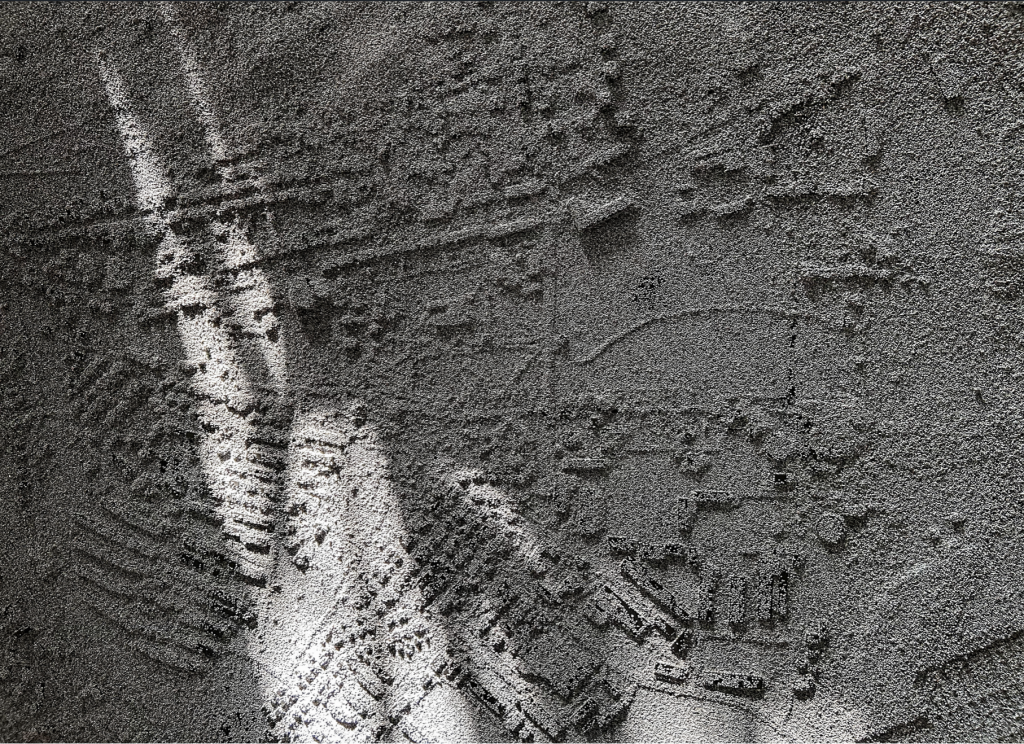
Radzionków is Maciek Cholewa’s hometown, and the postcard he found has become the starting point for an exhibition that develops his long-standing research into locality, peripherality and their tensions with the global. Rumor Has It does not propose an alternative vision of tomorrow, nor does it offer another utopia. Cholewa is interested in the moment when the future loses its sharpness and resists unequivocal representation. The indistinct, the dispersed and the incomplete do not function here as deficiencies, but as conditions of the present: a world too complex to be apprehended at a single glance.
When speaking of vision and modernity, Descartes inevitably comes to mind: for him, seeing was not just one of the senses, but a method of cognition and a way of ordering the world. The futuristic postcard operates precisely within this regime: it presents the future as something that can be seen in advance and designed. From this perspective, what matters is not the sharp, “knowledge-aided” eye, but an uncertain, peripheral gaze – one that relinquishes full control in favour of a multiplicity of possible interpretations.
Although peripherality remains one of the central concerns of Cholewa’s practice, it is not treated as a romantic alternative to the centre. The relation between centre and periphery is not based here on a simple opposition, but on a continuous circulation of imaginaries, desires and gestures of appropriation. The province is simultaneously idealised, aestheticised and subordinated to the expectations of the centre.
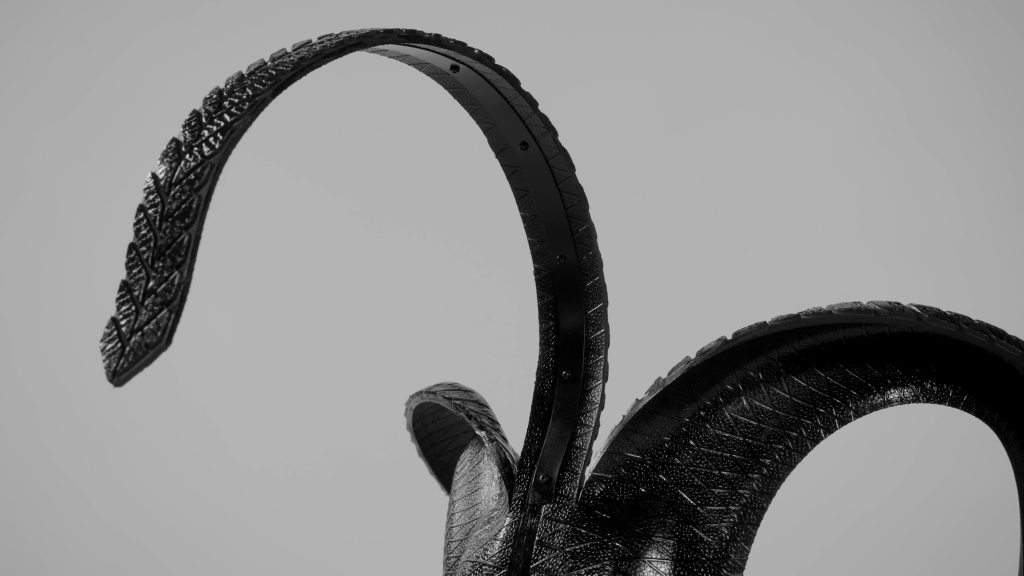
Let us imagine an order inverse to the one depicted on the postcard. In the near future, it is the great metropolis that becomes fascinated by provincialism, local folklore and small-town aesthetics. Cynically exploiting populist narratives, politicians decide to erect a monumental work: an oversized figure inspired by vernacular garden sculpture. The structure stands in the heart of the city, offering the creative classes aesthetic exoticism and a sense of symbolic proximity to “locality.”
Shortly after its unveiling, however, the harmonious narrative begins to fracture. What was intended as evidence of openness and reconciliation between centre and periphery reveals conflicts that can no longer be neutralised through aesthetics. Cholewa’s narrative, however, is not a fantasy of provincial revenge; rather, it suggests that the future designed by centres of power need not be a shared or universally accepted future.
Maciek Cholewa’s exhibition does not seek to restore a lost faith in progress or formulate a new vision of what is to come. Instead, it leaves us among images that are only beginning to emerge, already disintegrating or still dreaming of their own form. In this sense, the retrofuturistic postcard from the early 20th century remains a special figure – not because it failed to predict the future accurately, but because it continues to expose our desire to make both the future and the past visible: to subject them to a discerning gaze, organise them and render as coherent images.
Biographies
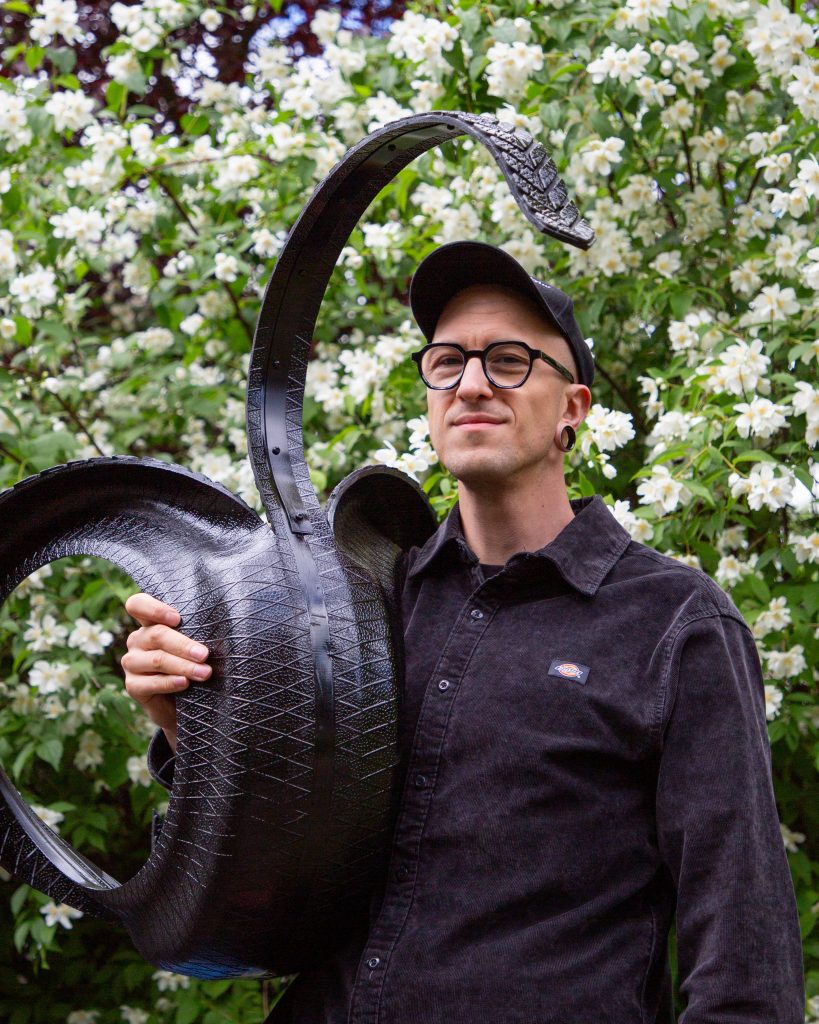
Maciek Cholewa (born 1991 in Siemianowice Śląskie) is a visual artist. He graduated from the Academy of Fine Arts in Katowice. He creates objects, installations, drawings, and photographs. His practice combines artistic, research, and literary activities, creating works embedded in local socio-cultural contexts. He focuses on themes related to the periphery, local identity, and vernacular aesthetics. He draws on his own short narrative forms and the reworking of stories he has heard. He comes from Radzionków, a small town he considers an important source of reference and inspiration.
His work has been presented at venues including the Kronika Center for Contemporary Art, the TRAFOstacja Sztuki in Szczecin, the Bielska BWA Gallery, the EL Gallery, the Gdańsk City Gallery, the Widna Gallery, MOCAK, the BWA Katowice Gallery, the Labirynt Gallery, and the Art Gallery. Jan Tarasin, Szara Kamienica Gallery, Szara Gallery, Wozownia Art Gallery, and Piktogram Gallery. Finalist of the following competitions: Vordemberge-Gildewart Foundation Award, Trójka Talents, Przypływ. Young Polish Art, and the Grey House Foundation Competition.
photo by Momo Młynarska
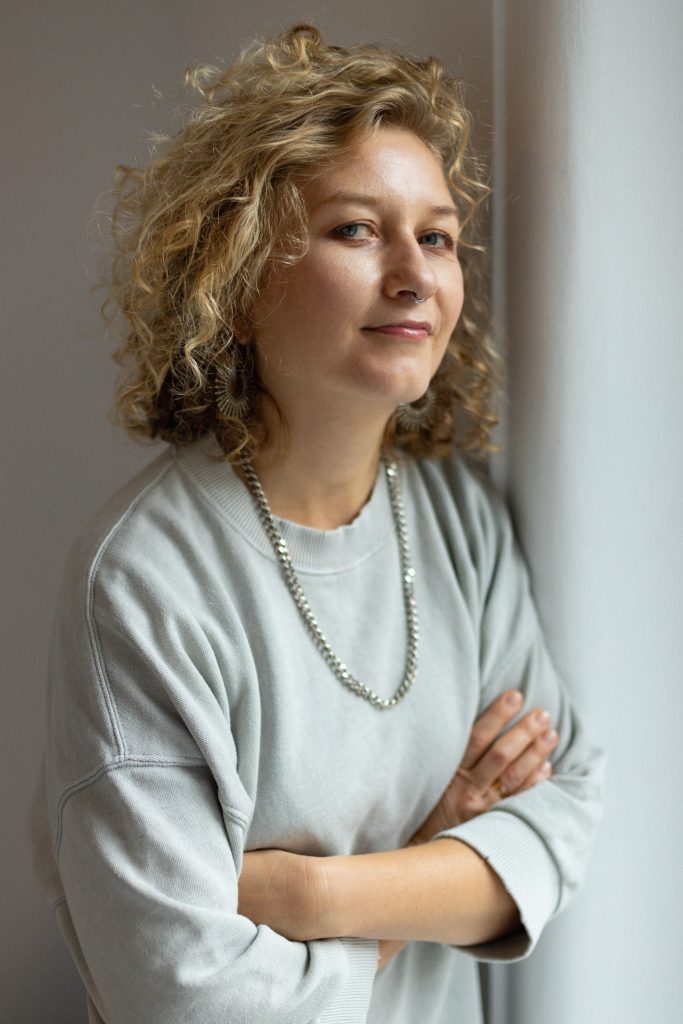
Joanna Kobyłt-Schodowska is an art historian and critic, curator, and researcher. She is a member of the Polish Section of the International Association of Art Critics (AICA) and a winner of the Wrocław Art Award (2023). She has published in publications such as Obieg, Szumiе, Notes na 6 Ciężki, and Dwutygodnik. She currently works at BWA Wrocław, where she runs the BWA Wrocław Główny gallery. In her curatorial practice, she works with historical context; she considers modernity as an era that informs our contemporary existence, as well as the exhibition medium as a tool of knowledge and power, shaping systems of perception and understanding history and our own present.
photo by Alicja Kielan
The 66P team and collaboratorse
organisation, production, and implementation: Renata Jarodzka, Rafał Jarodzki, Anna Krukowska, Mirek Łuckoś, Mirek Chudy, Patrycja Ucieklak, Łukasz Bałaciński, Danuta Krzywicka, Teresa Hajłasz-Golonka, Michał Czapliński, Katarzyna Małolepsza, Kamil Olender, Helena Swirtun, Alicja Wojakowska
promotion: Fest Promo
graphic design: Ewa Głowacka
translations: Iuliia Lytsevych, Karol Waniek
media patrons: MINT Magazine, Miej Miejsce, Notes na 6 Tygodni, Radio Wrocław, Radio RAM, Radio Wrocław Kultura