
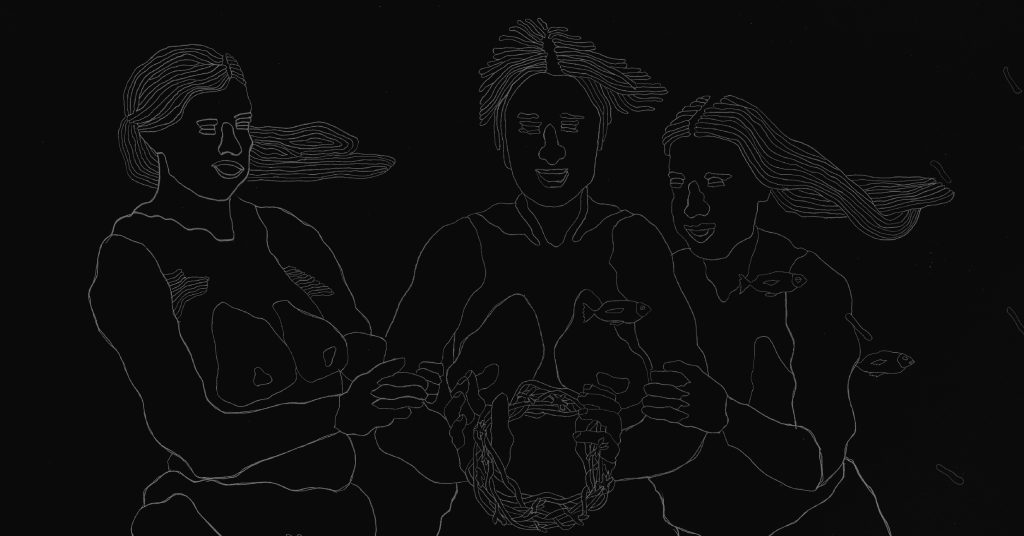
Liliana Zeic’s exhibition The First Year They Sleep, the Second Year They Creep, the Third Year They Leap unfolds as a queer-ecological ballad – a narrative form that, by its very nature, combines heterogeneous, often contradictory elements into one whole. This syncretism, which defies genre and species boundaries, was emblematic of the Romantic period, offering a vision of the world and of humanity that stood in stark contrast to Enlightenment rationalism. Zeic deliberately uses this form. The narrative’s point of departure is a folk legend surrounding Lake Świteź, quoted in Adam Mickiewicz’s 1822 volume Ballads and Romances, widely recognised as the first example of Polish Romanticism.
According to the legend, Lake Świteź conceals the secret of a submerged city. The tale dates back to the 11th century, when the Grand Duchy of Lithuania was attacked by Ruthenia. As the men left to defend the land, the city was left to its women. Upon being besieged, the women of Świteź chose death over submission. At that moment, a miracle occurred: the earth opened and engulfed the city, and in its place emerged a lake of extraordinary beauty. Upon its surface bloomed flowers of an unprecedented kind – the transformed women of Świteź. These plants lured the invaders with their intoxicating scent and form, only to cause their demise upon being picked, thus becoming both a symbol of courage and a curse to those who disturbed them. Other variations of the legend suggest that the city’s denizens continue to live beneath the lake, their songs still audible on certain nights.
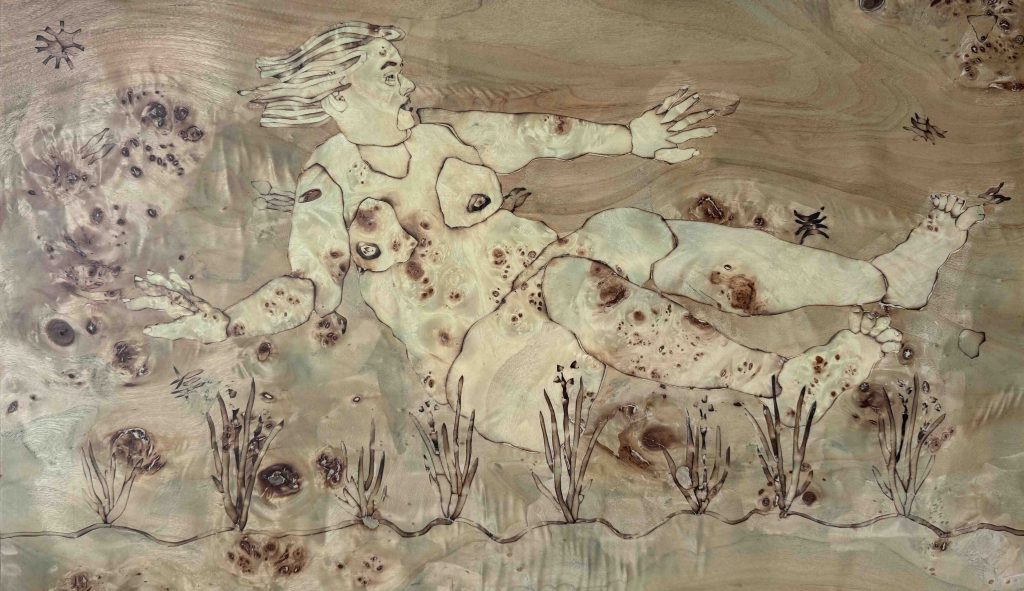 Liliana Zeic, Algae of Świteź and a Woman Floating in Water, from the series Świteź, 2025, intarsia, poplar burl, steel, 72 x 63 cm (detail)
Within the exhibition, Zeic immerses us in this submerged realm, reimagined through queer and ecofeminist sensibilities. In a series of intarsia works, feminine forms intertwine with botanical ones; identities blur, subjectivities coalesce. The dynamic of this entanglement is articulated through gestures of care, sacrifice, and tactile connection. These damp depths widen sensory perception, transcending the visual and ushering viewers into a realm beyond the anthropocentric. In Zeic’s telling, the shared ground between queer and plant ecologies is cultivated by oddities, outcasts, recluses, relict species, natural anomalies, and maladies. It is in these marginal, submerged zones that hybrid life-forms and untamed beauty begin to flourish.
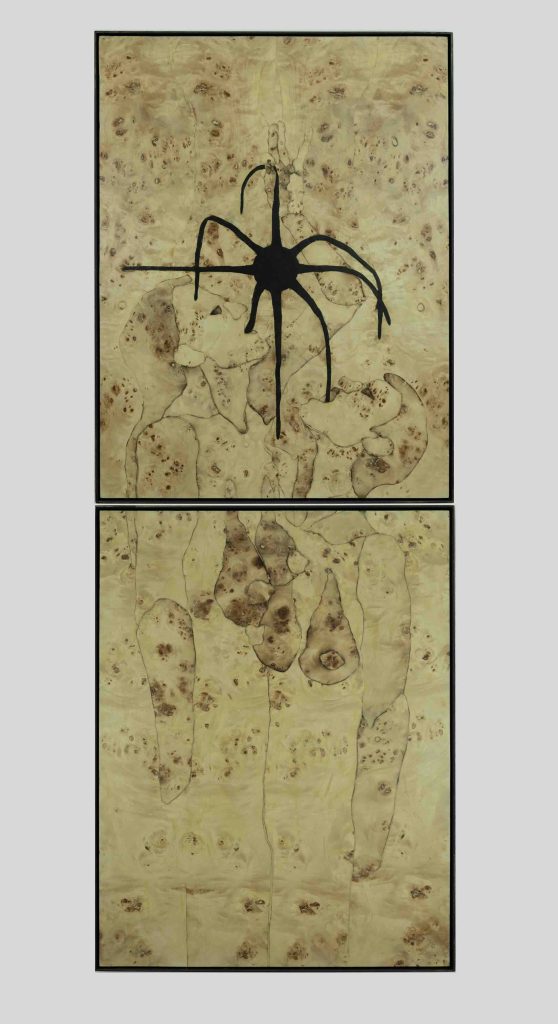 Liliana Zeic, Sun-Eaters II, 2024, intarsia, poplar burl, steel, 124 x 94 cm
The exhibition’s title alludes to a gardening proverb describing the developmental rhythm of perennial plants. In their first year, they grow imperceptibly, as if asleep. In the second, they invest their energy underground, establishing a foundation. Only in the third year do they flourish above the surface. The care and patience in this cycle lead to a reflection on the corporeal processing of trauma, which may yield not only restoration but also the forging of a more resilient, stronger self. Here, trauma becomes the substrate for a generative reimagining of identity.
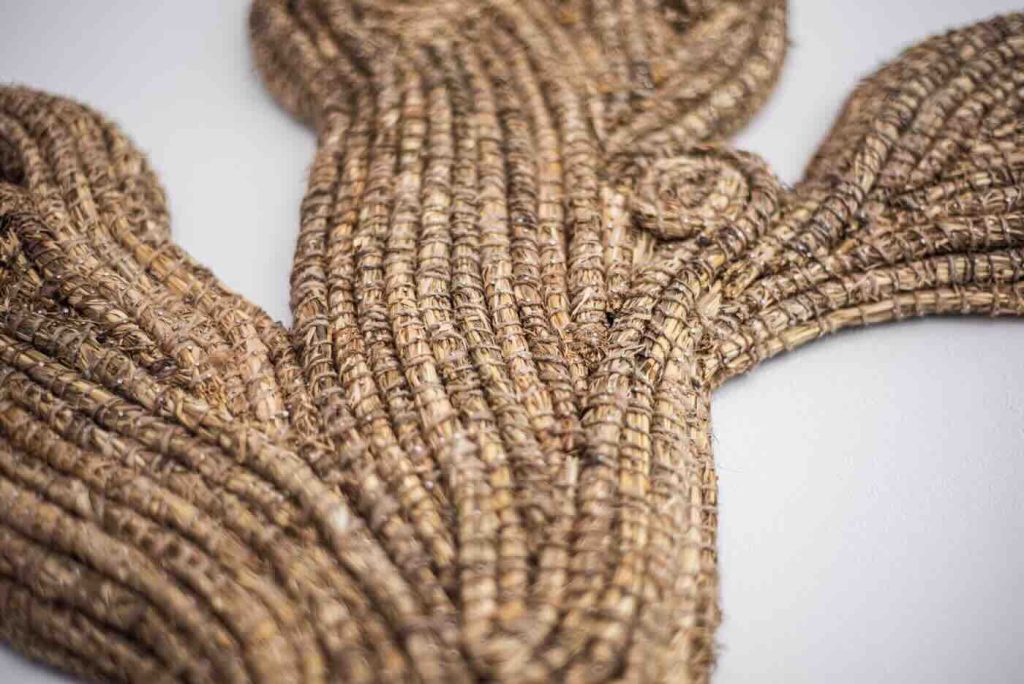 Liliana Zeic, Apples Grow on Oak Trees 2021, object (meadow hay, nettle fiber cord, pins), 115 x 61 x 4 cm (detail)
An essential context for this work lies in the artist’s personal history – her early immersion in craft through her parents’ carpentry workshop, her upbringing in the Polish countryside, and her experience within a co-dependent family structure. The exhibition is thus situated at the intersection of two social orders: the family of origin – one “not of choice” – and the prospective world of “those yet to come” – a community forged through human-plant-queer affiliations. In Zeic’s vision, the boundary between these orders is blurred. The folkloric tale is reactivated as a way of building a utopian vision of difference and interdependence. At the same time, the exhibition operates as a queer strategy of reclaiming visibility, processing trauma, honouring memory, and circulation of all life forms.